

Resume Screening vs Skill-Based Hiring: Key Differences
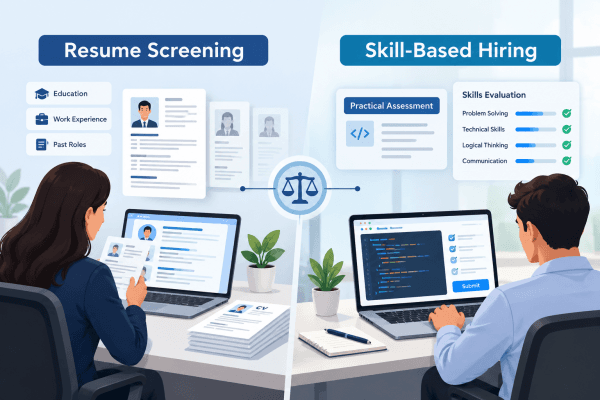
Resume Screening vs Skill-Based Hiring: Which Approach Helps Businesses Find Better Talent?
Most hiring teams begin with the resume. A recruiter reads education, job titles and technology lists, compares them with the job description and decides who deserves an interview. It is fast, familiar and, for many roles, necessary.
But a resume is a claim, not a demonstration. It tells you what a candidate says they have done; it rarely shows how well they do it. Skill-based hiring (also called skills-based recruitment) fills that gap by evaluating demonstrated capabilities, through work samples, job-related assessments and structured interviews, against what the role actually requires.
This guide compares resume screening vs skill-based hiring: what each involves, where each helps and falls short, how they apply to IT recruitment, where AI fits, and how to combine them into one candidate screening process.
What Is Resume Screening?
Resume screening is the process of reviewing applications to decide who moves to the next stage. A typical resume screening process includes:
• Reviewing education and qualifications.
• Checking employment history and career progression.
• Evaluating how relevant the candidate’s experience is to the role.
• Identifying required skills, tools and certifications.
• Comparing each resume with the job description.
• Shortlisting candidates for interviews.
Screening can be manual, where a recruiter reads each resume, or AI-assisted, where software parses resumes, extracts skills and experience, and ranks profiles against the job description. In both cases the evidence is the same: what the candidate has written about their own history.
Where resume screening works well
Resumes are an efficient way to confirm basic eligibility, understand career history and see which technologies, domains and certifications a candidate has worked with. They help recruiters build an initial shortlist before investing time in deeper evaluation.
Where it falls short
Resume formats vary widely, keywords may not match across employers, skills can be overstated or listed without context, and career gaps or nontraditional paths can be misread. None of this makes resumes unreliable; it means they are best treated as a starting point.
What Is Skill-Based Hiring?
Skill-based hiring evaluates a candidate’s demonstrated abilities in relation to the job. Instead of inferring ability from titles and years of experience, the employer asks candidates to show relevant skills. Common methods include:
• Practical work samples.
• Job-related skills assessments.
• Technical tests and coding exercises.
• Structured interviews with consistent questions.
• Role-specific problem-solving tasks.
• Portfolio and project reviews.
• Communication and other professional skills the role depends on.
The key distinction is between claiming a skill and demonstrating it. A resume line reading “Python, 4 years” is a claim. A candidate explaining how they structured a data-processing job in Python, and what they would change, is a demonstration.
Good assessments share four traits: they are job-related, accessible, consistently administered and proportionate to the role. A two-hour unpaid task for a short contract is rarely proportionate. The US Office of Personnel Management’s guidance on assessment and selection makes a related point: effective assessment starts with a job analysis of the duties and competencies involved, and a tool’s predictive validity, meaning how well its scores forecast job performance, is its most important quality.
Resume Screening vs Skill-Based Hiring: Key Differences
The table below summarizes how the two candidate evaluation methods compare. Neither column is “the winner”; each answers a different question.
| Comparison factor | Resume screening | Skill-based hiring |
| Primary focus | Career history and qualifications | Demonstrated job-related capabilities |
| Main evidence | Resume, education, experience | Work samples, assessments, projects and interviews |
| Initial screening speed | Can be quick for basic eligibility | Depends on assessment design and administration |
| Practical ability | Usually inferred from resume evidence | Evaluated more directly |
| Candidate experience | Often involves a resume review | May require additional candidate effort |
| Recruiter workload | Can be high for large applicant volumes | Depends on the assessment and evaluation process |
| Potential bias | May be affected by resume presentation and background signals | May be affected by test design, accessibility and scoring |
| Technical recruitment | Helps identify relevant experience and technologies | Can demonstrate job-related technical capability |
| Best use | Initial eligibility and experience review | Validating relevant skills and competencies |
| Limitations | May overlook transferable or poorly described skills | May not fully capture real-world performance or teamwork |
Advantages of Resume Screening
• Efficient experience review. A recruiter can see roles, tenure and technologies at a glance.
• Clear eligibility checks. Required qualifications, licences or certifications are easy to confirm.
• Career progression. Resumes show how responsibility has grown over time.
• Projects and certifications. Relevant projects, tools and credentials are visible up front.
• A workable first shortlist. Essential criteria filter a large pool before deeper evaluation.
Results improve when the job description is specific and every recruiter applies the same criteria. If the job description is vague, screening quality drops regardless of who or what does the screening.
Limitations of Resume Screening
• Keyword mismatch. A filter for “Kubernetes” may miss a candidate who wrote “container orchestration on EKS.”
• Formatting noise. Dense layouts, tables or unusual structures can hide relevant detail, especially from parsers.
• Skills without context. A technology listed in a skills section does not show how deeply or recently it was used.
• Overlooked transferable skills. A QA analyst with strong scripting experience may not be considered for an automation role.
• Nontraditional paths. Self-taught developers, career changers or candidates with gaps may receive less consideration.
• Volume. Careful manual review becomes hard to sustain when applications multiply.
Advantages of Skill-Based Hiring
• More direct evidence of practical, job-related capability.
• Better visibility of transferable skills that a resume may not describe in the employer’s vocabulary.
• Consistent criteria when every candidate completes the same task and is scored on the same rubric.
• Less reliance on credentials where a degree or specific employer is not essential to the role.
• Stronger shortlisting evidence for hiring managers who need to compare candidates.
These benefits depend on sound design. A poorly chosen test produces confident-looking data about the wrong thing.
Limitations of Skill-Based Hiring
• Design effort. Useful assessments take time to build and maintain.
• Administration and scoring workload. Someone must review submissions consistently.
• Candidate fatigue. Long or unpaid tasks discourage strong candidates who have other options.
• Accessibility. Assessments must allow reasonable accommodations.
• Testing the wrong things. Exercises on technologies the job never uses add noise, not signal.
• Test versus real work. Performance under assessment conditions may not reflect day-to-day work or teamwork.
• Bias in poor design. Ambiguous instructions or subjective scoring can introduce their own bias.
The practical remedy is to keep assessments short, relevant and transparent: clear instructions, a stated time expectation and a scoring rubric agreed before candidates are reviewed.
Resume Screening vs Skill Assessments in IT Recruitment
In technical recruitment, the gap between a listed skill and a working skill can be wide, which is why many teams pair both methods. Here is how that plays out by role:
• Software developers, front-end and back-end engineers: the resume shows languages, frameworks and domain exposure; a small coding exercise or code walkthrough shows how the candidate reasons about the actual stack.
• Data analysts and data engineers: the resume shows tools and data scale; a short SQL or pipeline-design task shows how they handle messy data and trade-offs.
• Cloud and DevOps professionals: the resume shows platforms and certifications; a scenario discussion on deployment, monitoring or incident response shows operational judgment.
• QA engineers: the resume shows test tools; a task to design test cases for a sample feature shows how they think about risk and coverage.
• Contract developers and project-based technical teams: speed matters, so a brief, role-specific check often replaces a lengthy process.
A practical example. A resume says a candidate has four years of Java experience. A 30-minute project discussion can reveal whether that means building and maintaining services or maintaining someone else’s scripts. A short, job-related coding exercise on a problem similar to the real project then confirms how they apply it.
The assessment should mirror the job. Testing unrelated technologies or relying on trick questions measures test-taking, not ability to do the work.
How AI Can Support Resume Screening and Skills-Based Hiring
AI resume screening and recruitment automation can reduce repetitive work. Common uses include:
• Parsing resume information and extracting skills and experience.
• Matching candidate profiles to job descriptions.
• Identifying potentially relevant candidates in a large pool.
• Organizing screening results so recruiters can compare them.
• Supporting structured assessments and interview workflows.
For example, AI-powered candidate screening and skills matching from Talynce parses resumes, rates skills on the evidence in each resume, ranks candidates against a job description with a stated reason for each match, and can run screening calls and score video interviews. Its page states that recruiters, not the software, make the hiring decision.
Keep one distinction clear: AI-assisted screening organizes and interprets what candidates have written; it is not verified evidence of ability. Limitations to plan for include inaccurate data extraction, bias carried in historical data, missing context and over-reliance on automated scores. Use human review, job-related criteria, and require the tool to show why it ranked someone where it did. The NIST AI Risk Management Framework, a voluntary framework from the US National Institute of Standards and Technology, is a useful reference for managing the risks of AI tools.
How to Combine Resume Screening with Skill-Based Hiring
A workable skills-based hiring process keeps the efficiency of resume review and adds evidence where it matters:
1. Define the job requirements and the essential competencies.
2. Write a clear job description separating must-haves from nice-to-haves.
3. Screen resumes against essential eligibility criteria only.
4. Identify candidates whose experience or transferable skills appear relevant.
5. Use a role-specific assessment where it adds value.
6. Run structured interviews with the same questions for every candidate and one scoring scale, as described in OPM’s structured interview guidance.
7. Review the combined evidence side by side.
8. Decide with human judgment, using the evidence rather than a single score.
Combining stages helps because each covers the other’s blind spot. The resume gives context a test cannot, and the assessment gives practical evidence a resume cannot. A single test or a single resume read leaves one of those gaps open.
When Should Businesses Use Each Approach?
| Hiring situation | Suggested emphasis |
| High-volume recruitment | Resume screening (manual or AI-assisted) against essential criteria first; short assessment only for the narrowed shortlist. |
| Entry-level hiring | Resumes show little track record, so short skills tasks or structured interviews add more signal. |
| Experienced professionals | Resume and project history carry weight; a focused technical discussion validates depth. |
| Specialized technical roles | Resume to confirm relevant stack; a job-related technical assessment to check depth. |
| Contract staffing | Speed matters; combine a quick resume check with a brief role-specific skills check. |
| Project-based hiring | Match to the project’s exact tools and deliverables; assess only those. |
| Roles requiring certifications | Verify required certifications from the resume or credentials; assess practical application separately. |
| Practical skills over formal education | Reduce reliance on degree filters; use work samples and portfolios. |
Qualifications that are legally required or genuinely essential, such as a professional licence, should remain requirements. The aim is to remove unnecessary filters, not essential ones.
Teams that hire contract developers often work to short timelines, so a lightweight, role-specific skills check alongside a resume review is usually more practical than a multi-round process.
How to Build a Better Candidate Screening Process
• Separate essential from preferred skills. Only essentials should filter candidates out.
• Use job-related, consistent criteria for every applicant.
• Avoid unnecessary degree or experience filters that do not predict performance in the role.
• Standardize resume screening with a shared checklist or scorecard.
• Design accessible assessments and offer accommodations.
• Use structured interviews with the same questions and rubric.
• Keep candidate data secure and limit who can see it.
• Review AI recommendations critically, asking for the reasoning behind rankings.
• Monitor selection outcomes across stages to spot patterns that could indicate bias.
• Tell candidates what to expect: format, time required and how results will be used.
Conclusion
Resume screening shows where a candidate has been; skill-based hiring helps show what they can do. The better question is not which to choose but how much of each a given role needs. Let role requirements, hiring volume, assessment resources and the evidence you need for a sound decision set the balance: lean on resumes for eligibility and experience, add job-related assessments where practical skill is hard to infer, and keep people responsible for the final call.
If you are looking for technical talent, OnBenchMark’s page to hire pre-vetted IT professionals on contract describes how businesses can find developers and consultants for contract and project-based needs, with candidates described as AI-interviewed and code-tested.
Frequently Asked Questions
Q1. What is the difference between resume screening and skill-based hiring?
Resume screening reviews a candidate’s documented history, such as education, roles and listed skills, to judge eligibility and relevance. Skill-based hiring evaluates demonstrated ability through work samples, assessments and structured interviews. One looks at what candidates say they have done; the other looks at what they can show.
Q2. Is skill-based hiring better than resume screening?
Not in every case. Skill-based hiring gives more direct evidence of ability, but it takes more time to design and run. Resume screening is efficient for initial eligibility. The better choice depends on the role, applicant volume and available assessment resources, and many teams use both.
Q3. How do recruiters assess candidates’ skills?
Common methods include role-specific skills assessments, coding or technical exercises, work-sample tasks, portfolio or project reviews, and structured interviews with consistent questions and scoring rubrics. Reference checks and certification verification can add supporting evidence.
Q4. Can AI improve resume screening?
AI can speed up parsing, extract skills, match resumes to job descriptions and organize results, which helps with large volumes. It can also misread resumes or reflect biased historical data, so its output should be reviewed by people and not treated as proof of ability.
Q5. How does skill-based hiring help IT companies?
IT roles often list many tools, and a listed technology does not show depth. Job-related coding exercises, project discussions or scenario questions give hiring teams clearer evidence of how candidates apply their skills, which supports decisions for developer, data, cloud and QA roles.
Q6. Can companies combine resume screening with skills assessments?
Yes, and it is a common approach. Resumes establish relevant experience and eligibility at the start; a short, role-specific assessment and a structured interview then add evidence of ability for shortlisted candidates. Combining stages gives a fuller picture than either method alone.