

Remote Hiring vs Hybrid Hiring: Which Model Is Right for Your Business
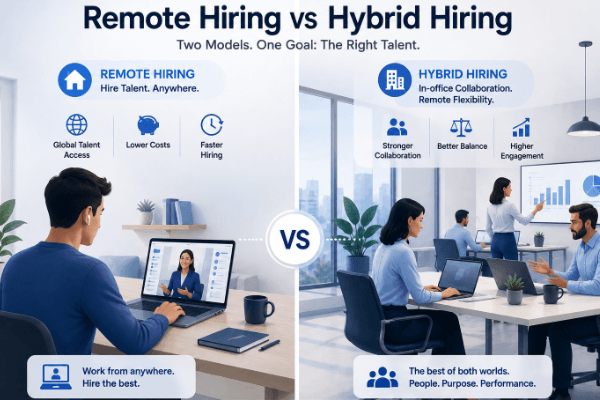
Remote Hiring vs Hybrid Hiring: Which Hiring Model Is Right for Your Business?
Hiring leaders no longer just decide who to hire - they have to decide where that person will work from, and that decision now shapes almost everything else about the hire: the size of the talent pool, the onboarding process, the tools required, and even the salary benchmark. Two models dominate this conversation: remote hiring and hybrid hiring.
Both models sit on opposite ends of a flexible-work spectrum, and both can work extremely well - or fail badly - depending on the role, the team, and the company's operating maturity. This guide breaks down remote hiring vs hybrid hiring across the factors that actually matter to employers: cost, talent access, productivity, collaboration, retention, and scalability, and gives you a practical framework to decide which model fits your next hire.
What Is Remote Hiring?
Remote hiring means recruiting and employing people who work entirely outside a physical office, regardless of their location. A remote workforce can be spread across cities, states, or even countries, connected through digital collaboration tools rather than shared office space.
For employers, remote recruitment typically means:
· Sourcing candidates without geographic restrictions
· Running interviews, assessments, and onboarding virtually
· Managing performance through outcomes and async check-ins rather than physical presence
· Relying on remote employees to self-manage their schedule within agreed working hours
This model is common in software development, customer support, content, design, and other roles where output can be measured independently of location. IT companies and startups building distributed teams frequently use this model to access specialized skills that may not exist locally.
What Is Hybrid Hiring?
Hybrid hiring means recruiting employees who split their time between working remotely and working from a physical office, following a set cadence (for example, three days in-office, two days remote). A hybrid workforce blends the flexibility of remote work with the structure and in-person collaboration of an office environment.
Hybrid recruitment usually involves:
· Hiring candidates who live within a commutable distance of an office or hub
· Setting expectations around in-office days, team overlap, or "anchor days"
· Balancing flexibility with face-to-face collaboration for certain functions
· Supporting hybrid employees with both physical workspace and digital tools
Hybrid work hiring is common among mid-sized and enterprise companies that want to preserve some in-person culture and mentorship while still offering flexibility to retain talent.
Remote Hiring vs Hybrid Hiring: Key Differences
The core difference between remote hiring and hybrid hiring is geographic constraint. Remote hiring removes location as a factor almost entirely, opening access to a national or global candidate pool. Hybrid hiring keeps location relevant, since employees still need to reach a physical office periodically.
This single difference cascades into nearly every other hiring decision:
· Talent pool size: Remote hiring casts a wider net; hybrid hiring is bounded by commuting radius.
· Collaboration style: Remote relies heavily on async communication and documentation; hybrid can lean on scheduled in-person time for complex discussions.
· Cost structure: Remote hiring can reduce real estate and relocation costs; hybrid hiring still requires office space, though often at lower density.
· Onboarding: Remote onboarding must be fully digital and self-serve; hybrid onboarding can mix in-person orientation with remote flexibility.
· Management approach: Remote management is outcome-driven by necessity; hybrid management can use a mix of in-person supervision and remote trust-building.
Neither difference makes one model universally "better" - it depends on the nature of the role and the company's operating model, which is why a direct comparison table is useful before deciding.
Remote vs Hybrid Hiring: Comparison Table
| Factor | Remote Hiring | Hybrid Hiring |
| Talent Pool | National/global; not limited by geography | Limited to commutable distance from office/hub |
| Cost | Lower real estate and relocation costs; potential regional pay variance | Moderate office costs; often standardized pay bands |
| Flexibility | High - employees choose their environment and often their hours | Moderate - flexibility within a fixed in-office schedule |
| Collaboration | Primarily async, tool-dependent (chat, video, docs) | Blend of in-person and digital collaboration |
| Onboarding | Fully virtual; requires strong documentation and digital processes | Can combine in-person orientation with remote flexibility |
| Productivity | Strong for focused, deep-work roles; depends on self-management | Can support both focused work and collaborative work |
| Management | Outcome-based, requires clear KPIs and communication discipline | Mix of direct supervision and outcome-based management |
| Employee Experience | High autonomy; risk of isolation without deliberate culture-building | Balance of independence and in-person connection |
| Scalability | Easier to scale quickly across geographies | Scaling tied to office capacity and hub locations |
Advantages of Remote Hiring
Wider access to talent.
Remote hiring lets employers recruit based on skill rather than proximity, which is particularly valuable for specialized IT roles, niche technical skills, or when local talent is scarce or expensive.
Lower fixed overhead.
Without the need to house every employee in a central office, companies can reduce real estate and facilities costs, redirecting that budget toward compensation or tooling.
Faster scaling across geographies.
A growing business can add contract or full-time remote employees in new markets without opening a physical office first - useful for startups testing new regions or IT companies building distributed delivery teams.
Higher retention for flexibility-driven employees.
Many skilled professionals, especially in tech, now treat location flexibility as a baseline expectation rather than a perk. According to the U.S. Bureau of Labor Statistics, 22.6% of U.S. workers teleworked in March 2026, underscoring that remote work has become a durable, structural part of the labor market rather than a temporary pandemic response.
Challenges of Remote Hiring
Communication gaps.
Without shared physical space, teams must be deliberate about documentation, meeting cadence, and async updates - otherwise misalignment builds up quickly.
Onboarding demands more structure.
New remote hires can't "absorb" culture by osmosis. Employers need clear onboarding checklists, mentorship pairing, and proactive check-ins to avoid early disengagement.
Time zone and collaboration friction.
For distributed teams spanning multiple time zones, scheduling overlap for real-time discussion, code reviews, or client calls requires intentional planning.
Harder to build spontaneous culture.
Hallway conversations, informal mentorship, and quick problem-solving over a desk don't happen automatically - they need to be recreated through virtual channels.
Advantages of Hybrid Hiring
Balance of flexibility and structure.
Hybrid hiring lets companies offer some autonomy while preserving in-person collaboration for complex projects, client meetings, or cross-functional planning.
Easier mentorship and onboarding for junior talent.
New hires, especially early-career employees, often benefit from in-person shadowing and direct feedback that's harder to replicate remotely.
Stronger informal culture-building.
Shared office days support relationship-building, spontaneous problem-solving, and stronger team cohesion - valuable for functions like sales, leadership, and cross-departmental coordination.
Broader appeal for candidates who want partial flexibility.
Not every candidate wants to be fully remote; hybrid hiring can attract talent that values face-time without wanting a full five-day commute.
Challenges of Hybrid Hiring
Talent pool remains geographically limited.
Even with flexible in-office days, hybrid hiring still requires candidates to live within commuting distance, which narrows the applicant pool compared to remote hiring.
Coordination complexity.
Managing which employees are in-office on which days, ensuring meeting rooms and desks are available, and aligning cross-team schedules adds administrative overhead.
Risk of "hybrid inequity."
Employees who come into the office more often can end up with more visibility and informal access to leadership than those who work remotely more frequently, creating a perceived - or real - fairness gap.
Office costs persist.
Even at reduced density, hybrid hiring still requires maintaining physical office space, which remote-only companies can avoid entirely.
Remote vs Hybrid Hiring: Which Is More Cost-Effective?
Cost-effectiveness depends on what a company measures. Remote hiring generally reduces fixed overhead - no need to lease large office space, less spending on facilities, and often more flexibility in compensation benchmarking across regions. For a growing business trying to control burn rate, remote hiring can meaningfully lower cost-per-employee.
Hybrid hiring doesn't eliminate office costs, but it can reduce them relative to a fully in-office model - companies often shift to smaller offices, shared desks (hot-desking), or regional hubs instead of one large headquarters. The savings are real but generally smaller than a fully remote model.
The more relevant cost question for most employers isn't just rent - it's cost of a bad hire or a slow hire. A role left unfilled for weeks because of a narrow, hybrid-only local search can cost more than any office savings. This is where remote talent acquisition or contract-based hiring can offer a faster, lower-risk path: filling a skill gap on a contract or project basis without committing to permanent overhead, then converting to a longer-term arrangement once the fit is proven. OnBenchMark's guide on when a company should choose contract staffing over a full-time hire walks through this decision in more detail.
Which Hiring Model Works Best for Different Roles?
There's no single correct answer - the right model depends on the nature of the work and the stage of the business.
Startups and early-stage teams often benefit from remote hiring because it lets a small team access senior talent without geographic limits or the cost of an office lease. A two-person founding team hiring their first developer, for example, can move faster by hiring remotely rather than restricting the search to their home city.
IT companies and software teams frequently favor remote or hybrid hiring for engineering roles, where output is measurable through code, deliverables, and sprint velocity rather than physical presence. Distributed engineering teams also allow "follow-the-sun" coverage across time zones.
Growing businesses scaling sales or client-facing teams often lean hybrid, since relationship-building, negotiation, and client trust can benefit from in-person interaction, at least periodically.
Roles requiring heavy mentorship, compliance oversight, or hands-on training (e.g., early-career hires, regulated industries, hardware-dependent work) tend to fit hybrid or in-office models better, since supervision and knowledge transfer are more efficient face-to-face.
Specialized or scarce-skill roles (niche technical expertise, specific certifications, rare language or domain knowledge) are usually easier to fill through remote hiring, simply because the qualified candidate may not live near any office.
A practical decision framework:
1. Can the role's output be measured independently of location? If yes, remote hiring is viable.
2. Does the role require frequent, complex, real-time collaboration or mentorship? If yes, hybrid may serve better.
3. Is the required skill set scarce locally? If yes, remote hiring expands your options significantly.
4. Does the company have mature async processes and documentation? If not yet, hybrid can be a transitional step while those muscles are built.
How to Build an Effective Remote or Hybrid Hiring Strategy
1. Define the role's true location requirements first.
Before writing the job description, decide honestly whether the role needs physical presence, and how often. This shapes the entire remote hiring strategy or hybrid plan that follows.
2. Standardize your interview and screening process.
Whether hiring remote or hybrid employees, structured interviews with consistent scorecards reduce bias and speed up decision-making - especially important when comparing candidates across different locations.
3. Invest in onboarding documentation.
Remote and hybrid hires both benefit from a clear, self-serve onboarding path: access to tools, a 30/60/90-day plan, and a named point of contact for questions.
4. Use technology to reduce screening bottlenecks.
As candidate volumes grow, manually reviewing resumes and scheduling interviews becomes a bottleneck. Tools offering AI-powered recruitment, such as Talynce, can help recruiters screen resumes, rank candidates, and schedule interviews faster - useful for both remote recruitment and hybrid hiring pipelines with high applicant volume.
5. Set clear communication norms.
Define response-time expectations, meeting cadence, and documentation standards so remote and hybrid employees know exactly how the team collaborates.
6. Consider contract or bench-based hiring for flexibility.
For companies unsure whether a role should be permanent, remote, or hybrid, hiring on a contract basis first allows testing the working model before committing to long-term overhead. OnBenchMark's overview of how to evaluate a B2B hiring platform for contract staffing is a useful starting point for teams building this kind of flexible workforce strategy.
7. Revisit the model as the team scales.
What works for a 10-person startup may not work at 100 employees. Periodically reassess whether remote, hybrid, or a mix best serves each department.
Conclusion
Remote hiring and hybrid hiring both solve real business problems - they just solve different ones. Remote hiring maximizes talent access and minimizes fixed costs, making it a strong fit for specialized roles, distributed engineering teams, and lean startups. Hybrid hiring preserves in-person collaboration and mentorship while still offering flexibility, making it a strong fit for client-facing roles, early-career hires, and teams still building async-first habits.
The most effective hiring strategies don't pick one model dogmatically - they match the model to the role. For businesses that want to test a role's requirements before committing to a permanent remote, hybrid, or in-office structure, contract-based hiring offers a lower-risk way to build the right team composition over time.
Ready to hire smarter?
Visit OnBenchMark, India’s No. 1 contract hiring portal, and hire pre-vetted contract talent in one day.
FAQs
Q1. Remote hiring vs hybrid hiring - which is better?
Neither is universally better. Remote hiring offers a larger talent pool and lower fixed costs, while hybrid hiring offers more structured in-person collaboration and mentorship. The right choice depends on the role, team maturity, and business stage.
Q2. What are the main benefits of remote hiring?
Access to a wider, often global, talent pool; lower real estate overhead; faster scaling across new markets; and strong appeal to candidates who prioritize flexibility.
Q3. What are the main benefits of hybrid hiring?
Easier mentorship and onboarding for junior employees, stronger in-person culture-building, and flexibility that still preserves some structured office time.
Q4. How do I decide whether to hire remote employees or hybrid employees for a role?
Start by asking whether the role's output can be measured independently of location and whether it requires frequent real-time collaboration or hands-on supervision. Roles with measurable output and low supervision needs suit remote hiring; roles needing frequent mentorship or in-person coordination often suit hybrid.
Q5. Is remote hiring more cost-effective than hybrid hiring?
Generally, yes, in terms of fixed overhead like office space, since fully remote teams don't require any physical workspace. However, total cost-effectiveness should also account for hiring speed, retention, and productivity, not just real estate savings.
Q6. How can businesses build an effective remote or hybrid hiring strategy?
Define location requirements per role, standardize interviews, invest in onboarding documentation, use recruitment technology to handle screening at scale, and consider contract-based hiring to test a working model before committing to a permanent structure.